The Dangerous Myth of Dip & Pay in Oil Trading | Fake Buyers, Zero Commitment & No Real Cargo

3 Reasons Dip and Pay Oil Trading Never Leads to Real Cargo Luxury Editorial Insight 1st Class Group Pte Ltd Home Market Update Services Contact Oil & Gas Verification Insight The Dangerous Myth of Dip & Pay in Oil Trading Fake buyers continue chasing a fantasy structure that does not exist in the real petroleum market. The truth is simpler, harsher, and far more expensive: no serious seller moves real cargo across half the world without real commitment. Published: 08 March 2026 Reading time: 8–10 minutes Category: Diesel Trading Reality Core Reality If you would not spend millions leasing tanks, chartering vessels, and carrying storage exposure before securing a true buyer, no genuine supplier will do it either. Dip and pay oil trading is one of the most misunderstood and misleading ideas circulating in the petroleum market today. The phrase sounds simple. The promise sounds attractive. The fantasy sounds safe. A buyer imagines that a seller has already placed diesel in storage, already paid the freight, already paid the terminal, already carried the risk, and is now patiently waiting for an unknown buyer to arrive, dip the tank, and only then decide whether to pay. It is an appealing story. It is also commercially absurd. In legitimate oil and gas transactions, there is no such thing as a real Dip & Pay deal. More importantly, there is also no such recognised term used in serious refinery-backed or professionally structured petroleum transactions. What circulates under this label usually comes from fantasy broker chains, recycled scam procedures, or buyers who have been taught to believe they can somehow obtain cargo with zero commitment. The simple truth: no financial commitment from the buyer means no cargo from the seller. What People Think Dip & Pay Means Under the fictional Dip & Pay narrative, the procedure supposedly works like this: The seller already has diesel sitting in a storage tank. The buyer is invited to visit the terminal. The buyer dips the tank to verify quantity. The buyer only pays after confirming cargo. To someone unfamiliar with actual petroleum logistics, this may sound cautious and clever. It creates the illusion that the buyer has all the protection while the seller absorbs all the risk. That is precisely why the idea keeps attracting inexperienced participants. The entire story collapses once one obvious question is asked: Who is paying for everything before the buyer even proves they are real? Why Dip and Pay Oil Trading Does Not Exist in Real Transactions Let us be direct. The way Dip & Pay is commonly described in the market is nonsense. It is not a serious commercial mechanism. It is not a recognised payment structure. It is not a legitimate buyer-protection model used by disciplined suppliers. In real terminal operations, tank dipping is simply a technical gauging activity. It is a method used by authorised terminal personnel or appointed inspectors to determine liquid levels and volume measurements. It is not a magical commercial trigger that allows a buyer to appear at the last minute, inspect millions of dollars of product, and then decide whether to pay. Buyers do not casually walk around professional terminals carrying out their own informal “dip test” as though they are shopping in a retail warehouse. Real terminals are controlled environments. Access is regulated. Procedures are documented. Operational actions are performed by approved personnel, not by fantasy buyers following internet procedures. In real petroleum trading, product verification is not “Dip & Pay.” It is pre-loading sample collection for Certificate of Quality testing. That is the actual process. Before loading, authorised inspectors may collect samples from the storage tank. Those samples are then tested to verify whether the product meets contractual specifications. The results are reflected in a Certificate of Quality (COQ). This is a technical quality-control procedure tied to loading operations, not a zero-commitment payment fantasy. A Simple Logic Test Every Buyer Should Apply Put yourself in the seller’s position. Would you spend millions purchasing or allocating diesel before confirming that the buyer is real? Would you lease expensive tank storage without secured payment arrangements in place? Would you charter a vessel, whether on time charter or ad hoc basis, and send it across half the ocean just to “look for a buyer”? Would you pay freight, marine insurance, port charges, terminal fees, handling costs, and storage exposure while waiting for someone to decide later? Would you tie up working capital in a volatile commodity market without serious payment security? Of course not. No rational supplier would do this. No serious broker with real capital would do this. No experienced trader burns large sums of money before securing a buyer who has demonstrated financial capability. So if that logic makes no commercial sense, the next question becomes unavoidable: Where do all these Dip & Pay deals come from? The answer is simple. They come from people who do not control real cargo. When there is no actual product, no actual vessel, no actual terminal arrangement, and no real capital at risk, it becomes very easy to invent fictional procedures and market them to naïve buyers. The Economics of Real Cargo Make the Myth Collapse Petroleum cargo does not casually sit in storage tanks waiting for unknown buyers to show up. Before diesel even reaches a terminal, serious costs and commitments have already been made, often including: Refinery allocation or product purchase Vessel chartering or freight exposure Marine insurance Port dues and agency costs Terminal handling and storage fees Pumping, coordination, and operational support Inspection, documentation, and compliance-related work For cargoes involving EN590, ULSD 10ppm, and other refined petroleum products, the total value and cost exposure can reach tens of millions of dollars. A serious seller does not deploy this capital simply to satisfy a buyer who refuses even basic commercial commitment. This is why dip and pay oil trading remains a misleading phrase that does not reflect how genuine petroleum transactions are structured. Every day of storage costs money. Every delay increases exposure. Every
Buyer Qualification Program: Verified Seller Access for Real Buyers
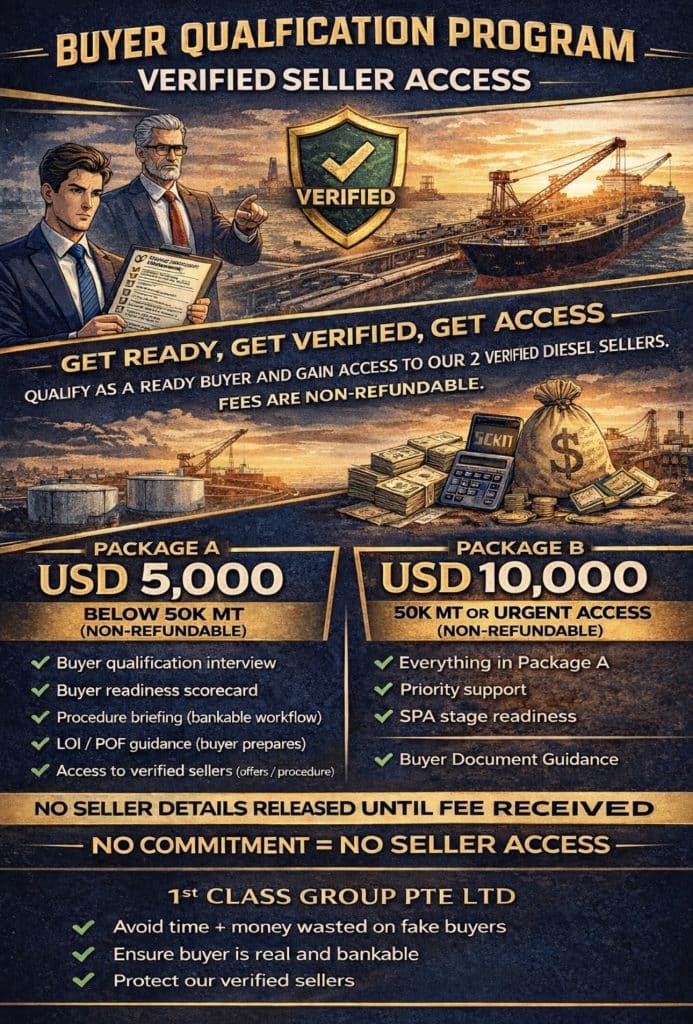
VERIFIED SELLER ACCESS • BUYER QUALIFICATION • SINGAPORE Buyer Qualification Program: Verified Seller Access for Real Diesel Buyers We do not introduce paper buyers to verified sellers. Allocation is protected, time is respected, and execution is disciplined. If you are bankable and ready, we deliver. If you are collecting documents, we disengage. Transaction-Level Access. Our Buyer Qualification Program is a professional filter that protects verified seller allocation from ICPO template abuse, document harvesting, and non-performance. No seller details are released until the qualification fee is received. Allocation Protected Fraud Filtered Bankable Workflow Singapore-Based Standards View Packages Request Qualification Contents Why Serious Buyers Pay for Verified Seller Access Market Reality: Fake Buyers Burn Allocation ICPO Fraud: The “Paper Buyer” Pattern What You Get (Deliverables) What “Bankable Buyer” Actually Means How the Process Works Packages & Pricing Singapore Compliance & Why We Operate Strictly FAQ Next Step Why Serious Buyers Pay for Verified Seller Access In diesel trading, access is not about “having an ICPO.” It’s about protecting allocation and moving through a bankable workflow without noise. Every introduction consumes seller bandwidth—legal, compliance, and operational. Verified sellers will not repeatedly entertain unqualified approaches. Non-negotiable truth: If a buyer hesitates at a USD 5,000–10,000 qualification fee, they are not prepared for cargo-scale execution. The qualification fee is not a barrier. It is a filter that protects sellers and accelerates legitimate buyers into real execution channels. Market Reality: Fake Buyers Burn Allocation The market is saturated with “buyers” who cannot perform. Verified sellers get targeted daily by: Template ICPO submissions (copied, unrealistic, endlessly revised) Demands for POP first or “seller identity for confirmation” (often bypass intent) Document harvesting and “procedure shopping” Fantasy narratives: “no commitment, no deposit” Middlemen misrepresenting mandate or end-buyer status We refuse to waste time and we refuse to burn allocation. Our program exists because we protect what is scarce: verified seller access. ICPO Fraud: The “Paper Buyer” Pattern ICPO abuse is one of the most common patterns behind stalled deals, document scams, and bypass attempts. Generic ICPO is submitted with unrealistic terms. Buyer demands POP or seller identity first. Buyer resists bankable workflow steps and pushes shortcuts. Documents get harvested; execution never happens. Mocking reality (because it’s accurate): An ICPO without bankable capability is a “serious offer” with no ability to perform—just words formatted nicely. We remove this risk before it touches our verified sellers. What You Get in Buyer Qualification We do not prepare KYC for buyers. We focus on readiness and workflow alignment—so sellers only meet buyers capable of execution. Core Deliverables Buyer Qualification Interview: capability, mandate, volume, destination, timeline Buyer Readiness Scorecard: pass/fail indicators and gaps to close Bankable Workflow Briefing: what real sellers accept (and what they reject) LOI / POF Guidance: buyer prepares; we guide structure and sequencing Verified Seller Access: access granted after fee + qualification completion Seller protection policy: No seller details are released until the qualification fee is received. What “Bankable Buyer” Actually Means “Bankable” is not confidence. It is the ability to perform within real compliance and banking constraints. Bankable Buyer Indicators Clear mandate (end-buyer or authorized representative) Credible proof of capability aligned with execution steps SPA stage readiness and timeline discipline Workflow compliance (no shortcut fantasies) Document discipline (no template spam, no harvesting) How the Process Works Inquiry: product, volume, destination, delivery basis, timeline Package selection: A (standard) or B (priority/large volume) Fee receipt: screening begins immediately (non-refundable) Qualification + scorecard: readiness confirmed and gaps closed Workflow briefing: clean sequencing for seller engagement Verified seller access: granted according to qualified scope Non-negotiables: No fee, no seller access. No commitment, no allocation exposure. No paper buyers. Packages & Pricing Standard Access Package A USD 5,000 For buyers below 50,000 MT. Buyer qualification interview Buyer readiness scorecard Bankable workflow briefing LOI / POF guidance (buyer prepares) Verified seller access (offers / procedure) Non-refundable. No seller details released until fee received. Priority Access Package B USD 10,000 For 50,000 MT+ or urgent access. Everything in Package A Priority support SPA stage readiness guidance Document sequencing discipline Non-refundable. No seller details released until fee received. Singapore Compliance & Why We Operate Strictly 1st Class Group Pte Ltd is a Singapore-registered company and we operate under a serious legal and compliance environment. Any attempt to misuse our channel for fraud, misrepresentation, or document harvesting will be disengaged immediately and documented. Official Reference Singapore Police Force – Caning for Scams and Scam-related Offences: https://www.police.gov.sg/Knowledge-Hub/Legislation/Caning-for-Scams-and-Scams-related-Offences This reference is provided for public awareness. We maintain zero tolerance toward scam-linked behavior. FAQ Is it normal to pay for verified seller access? Yes. Verified seller allocation and introduction channels are protected in professional markets. Paid qualification filters fraud risk and non-performance. Why are fees non-refundable? Because screening, readiness assessment, and allocation protection work begins immediately upon engagement. The fee covers professional services and risk control. Can we get seller details first and pay later? No. No fee, no seller access. We protect verified sellers from unqualified exposure. Is scam activity taken seriously in Singapore? Yes. Singapore treats scam and fraud-related offences extremely seriously, including enhanced criminal penalties. As a Singapore-registered company, we maintain strict standards and zero tolerance toward fraudulent buyer behaviour. Official reference: Singapore Police Force – Caning for Scams and Scam-related Offences . Do you prepare KYC for buyers? No. We focus on buyer readiness, workflow alignment, and document correctness guidance. Buyers prepare their own compliance materials as required by their bank and counterparties. What is the biggest red flag in buyer behavior? ICPO-only discussions with no bankable capability, combined with demands for POP or seller identity first. That pattern is strongly associated with fraud and non-performance. Next Step: Request Buyer Qualification If you are a real, bankable buyer ready to execute, contact us with your product, volume, destination, delivery basis, and timeline. Email: export@firstclassgroup.sg Website: www.firstclassgroup.com.sg Reminder: No seller details are released until fee is received. Serious buyers move forward. Speculators move on. Direct inquiries only: export@firstclassgroup.sg Related Reading Diesel Trading Scam Red Flags Bankable FOB
AVDS Scam Case Study: Tank Storage & Vessel Fraud Exposed
AVDS Scam Case Study: Tank Storage & Vessel Fraud Exposed 🚨 AVDS Scam Case Study: Protecting Clients From Costly Tank Storage & Vessel Fraud Published by: 1st Class Group Pte. Ltd. (UEN: 202319576M) Introduction In today’s volatile fuel and logistics markets, the real risk isn’t just price fluctuations or supply disruptions. Increasingly, fraudulent sellers and logistics providers present polished offers that mask deep flaws — costing businesses time, money, and credibility. This AVDS scam case study highlights why early verification is essential and why buyers should establish strict controls before releasing any funds. At 1st Class Group Pte. Ltd., we specialise in verification and risk management to protect clients from such traps. The following case study exposes how Authentic Venture Distribution Services (AVDS) used documents, invoices, and a Singapore-registered number to create a façade of legitimacy — and why our clients avoided becoming victims. The Problem: Risky Sellers Disguised as Reliable Operators Not every seller or logistics provider is worth your time. Some lack operational backing, some recycle generic paperwork, and others deliberately fabricate capacity. Warning signs include inflated claims, crypto-only payment demands, and inconsistent business details — all classic markers of an AVDS scam-type pattern. Case Study: AVDS Scam in Tank Storage & Vessel Fraud A company branded under AVDS claimed to provide tank storage and vessel services. On the surface, their documents looked viable. But our investigation uncovered a coordinated AVDS scam. Exhibit 1: The False Business Address (AVDS scam red flag) AVDS listed their address at People’s Park Complex, Singapore. When inspected, the registered office was not a logistics firm but a wellness & reflexology shop — proving no relation to tank storage or vessel operations and signalling an AVDS scam red flag. Exhibit 1A – AVDS registered address is actually a wellness shop. Exhibit 1B – Price list showing massage services, unrelated to logistics. Exhibit 2: The Invoice Trap (AVDS scam pattern) AVDS issued an invoice demanding USDT (TRC20) crypto payment for supposed demurrage charges — USD $325,000 for 5 days — with no vessel proof. Such crypto-only demands are a hallmark of an AVDS scam approach. Exhibit 2 – Fake invoice requiring USDT payment with no vessel proof. Exhibit 3: The Tank Storage Agreement (TSA) — AVDS scam contract signals Another client shared a Tank Storage Agreement provided by AVDS. Critical red flags included: Tank number left as “TBD” Boilerplate contract language No evidence of actual storage capacity Exhibit 3 – TSA document with missing details and no real storage allocation. Red Flag Checklist: Lessons from the AVDS Scam Unrealistic fees with no supporting evidence. Crypto-only payments outside regulated channels. Missing operational details such as TBD tanks. Contradictory claims about storage and vessels. Contracts with no proof of assets. Business address inconsistent with claimed operations. Multiple victims with similar losses. For official guidance on spotting and reporting scams similar to an AVDS scam, see the Singapore Police ScamAlert and INTERPOL Financial Crime resources. Zero Tolerance: Reporting the AVDS Scam to Law Enforcement At our firm, we uphold a zero-tolerance policy toward fraud. When scams are identified, we act decisively — exposing them and reporting to the relevant authorities. We have filed a report with the relevant law enforcement authorities regarding this AVDS scam. By doing so, we protect our clients and help create a more transparent, trustworthy marketplace. Report Filed With Law Enforcement To support accountability and public interest, 1st Class Group has submitted a formal report to the relevant law enforcement authorities regarding the AVDS matter. While we do not publish case numbers publicly, supporting documentation can be provided to authorities and subscribed clients upon request. Final Word The lesson is clear: not every seller or logistics provider is who they claim to be. But with the right verification and due diligence partner, businesses can avoid costly mistakes and focus only on opportunities that truly perform. Scams like the AVDS scam remind us that vigilance is non-negotiable in global trade. For a deeper dive into how due diligence prevents costly mistakes in fuel trading, read our article: EN590 Oil Trading – Why Verification & Due Diligence Can Save You Millions . 👉 Protect your business today — explore our annual subscription for verified opportunities only. Contact Us Company Name: 1st Class Group Pte. Ltd. Email: export@firstclassgroup.sg Contact Person: Christopher Lee Mobile: +65 8787 8953 ⚠️ DO NOT CONTACT US FOR OFFERS
EN590 Oil Trading: Why Verification & Due Diligence Can Save You Millions
EN590 Oil Trading Verification & Due Diligence: Save Millions | 1st Class Group Gasoil Division • Verification & Risk EN590 oil trading verification protects buyers against recycled POPs and fake logistics. EN590 Oil Trading Verification: Why Due Diligence Saves Millions Serious buyers treat EN590 oil trading verification as non-negotiable. In multi-million dollar CIF and FOB deals, our analysts validate POP documents, counterparties, and logistics so your EN590 verification clears fraud, compliance, and operational risks before you commit. On this page Why EN590 needs verification How due diligence works Compliance & AML Plans & pricing Enterprise perk Case studies Contact Why EN590 Oil Trading Requires Verification One fake POP, one unverifiable seller, or one fictional vessel can sink an entire deal. EN590 oil trading verification prevents loss by confirming document authenticity, mandate rights, and realistic trade flows backed by ports and refinery operations. Photoshopped POPs and recycled PDFs are common. Non-genuine ATS/SGS and product passports circulate widely. Shell entities & cloned domains impersonate real firms. Even 100,000 MT EN590 “offers” can be fabricated. How EN590 Due Diligence Saves Money Document Authenticity: Metadata, digital signatures, AATL, and recycle-detection. Trade Flow Logic: Refinery capacity, vessel tracking, port lineups, and berth limits. Corporate & Mandate Checks: Registries, WHOIS, tracebacks, and mandate right verification. Tank Farm & Vessel Validation: Discreet calls and database checks to validate real assets. Red-Flag Pattern Matching: Our internal fraud database detects repeats fast. Strategic Advisory: Go/No-Go decisions to avoid fake fees and legal exposure. Compliance & AML: A Non‑Negotiable Our EN590 verification includes KYC, AML, export controls, and sanctions screening (OFAC/EU/UN) with a clear risk summary your compliance team can file. Company legitimacy confirmation Email & contact traceability AML & sanctions checkpoints Risk summary with red flags The 1st Class EN590 Verification Plans ✅ Plan A: Essential (Ad Hoc) USD 4,800 per POP set Best for one-off EN590 oil trading verification. Full document review (up to 10 docs) Company, email & domain legitimacy check Digital signature & AATL check Plausibility review of trade flow PDF report with red-flag alerts 📌 Add-ons: Express 12hr turnaround, vessel trace, live consult ✅ Plan B: Pro (Monthly Subscription) USD 6,800 per month For active desks handling 3–5 offers; includes ongoing EN590 verification. Up to 5 POP sets verified monthly All features from Plan A 24–36 hour turnaround Live consultation (up to 2 sessions/month) Monthly summary of verified offers ✅ Plan C: Enterprise (Annual) USD 60,000 per year Unlimited EN590 oil trading verification for procurement teams. Unlimited POP reviews Dedicated analyst contact 24–48 hour turnaround Live reviews on request Custom-branded reports Quarterly compliance summaries 03 Zoom meetings representing buyer 01 face-to-face meeting if required Enterprise Client Perk: Verified EN590 Offers First Enterprise clients receive early access to verified EN590 offers from sellers and allocation holders that pass our checks. Three buyers have already secured clean allocations through this channel. Real Cases: Fraud Prevented, Millions Saved Fake Tank Farm (Korea): > USD 200,000 in fake “extension” fees avoided after we confirmed the operator wasn’t listed in port records. 🔗 (Case Study – coming soon) Invalid Seller Mandate (SG): Mismatched corporate docs and fabricated headers exposed. 🔗 (Case Study – coming soon) Fake Vessel STS Offer: Misused IMO + mid‑voyage STS promised; our EN590 verification proved it impossible. 🔗 Read Case Study (Fake Vessel) Fake Vessel & Storage Claim: Logistics didn’t align; wider scam ring uncovered. 🔗 Read Case Study (AVDS Scam) Short URL: https://firstclassgroup.com.sg/en590 For macro insights, visit IEA Mid‑Term Oil Report. 📩 Ready for EN590 Oil Trading Verification? Let’s Talk. We help you: Avoid costly mistakes in EN590 trades Uncover red flags before you commit Pass compliance reviews Secure offers from verified sellers 1st Class Group – Gasoil Division Expert EN590 Verification | Risk Management | Deal Intelligence 📞 Call/WhatsApp: +65 8787 8953 📧 Email: export@firstclassgroup.sg 🌐 Website: www.firstclassgroup.sg Send your EN590 POP now or book a Zoom consult for onboarding.
Stop Asking for SGS First

FOB EN590 10PPM Gasoil: Market Trends and Opportunities | 1st Class Group FOB EN590 10PPM Gasoil: Market Trends and Opportunities Last updated: 27 July 2025 FOB EN590 10PPM 1 · What Is FOB EN590 10PPM? FOB EN590 10PPM refers to a Free On Board transaction for ultra-low sulfur diesel meeting the EN590 standard. In genuine FOB EN590 10PPM deals, the seller first confirms cargo availability and issues an allocation letter. The buyer then provides RWA/BCL and lodges Proof of Funds (POF), which secures their slot. Next, the vessel is nominated and proceeds to the terminal manifold for sampling. Only after third-party SGS sampling and inspection is the certificate released and loading documents issued, ensuring trust and security. 2 · Why “SGS First” Became a Bad Habit Many brokers treat an SGS inspection certificate as the ultimate proof of cargo. They think, “If the seller pays for SGS first, I can show buyers real barrels and close faster.” In reality, leaking inspection paperwork destroys trust and invites document fraud. Professional sellers release SGS only after the buyer shows intent and capacity via Proof of Funds (POF). SGS Oil & Gas – What an Inspection Covers ICC Commercial Crime Services – Document Fraud Cases 3 · The Seller’s Nightmare – How Deals Die Seller spends US $7,000–10,000 on a fresh SGS. PDF circulates on WhatsApp & Telegram. Copy-paste “offers” flood the market. Legitimate desks blacklist the barrels. Seller pays storage & tank-time while cargo sits unsold. Bottom line: once an SGS is public, the cargo’s perceived exclusivity is gone. 4 · Why SGS Cannot Precede POF in an FOB Operation Sampling timing – final samples drawn only when buyer’s vessel is at manifold. Risk management – leaked certificates allow spoofing. Market dynamics – sellers have more buyers than slots; funds equal priority. Location reality – true FOB loads sail from Rotterdam or Fujairah; “FOB Jurong” is non-performing. Meme: “No money to pay first but give me your SGS!” 5 · FAQ – Common Objections & Myths “My buyer will pay the SGS fee upfront.” Sellers protect paperwork, not fees – certificate leakage remains the risk. “Can we use video proof?” Videos are spoofable and lack legal weight; banks require SWIFT proof. “Other brokers give SGS first.” That’s 99% seller-chain or scam territory. True desks know the correct flow. “How often is EN590 10PPM testing done?” Professional sellers perform third-party EN590 10PPM testing on every shipment at the loading terminal. 6 · Broker Success Checklist ✅ Educate buyer: SGS after POF. ✅ Clarify tank-activation & laycan fees. ✅ Demand genuine SWIFT, not screenshots. ✅ Secure all sensitive docs in a data room. 🚫 Never broadcast SGS, POP, or B/L externally. 7 · Why Real Sellers Don’t Chase Buyers Real EN590 10PPM sellers run continuous supply; allocations go to buyers who prove capability. Because they operate on long-term contracts, they never lack interested parties. If a broker approaches without solid POF and vessel details, the seller simply moves to the next qualified buyer. This ensures every drop of EN590 10PPM is sold to a buyer who can perform quickly. Deal flow never stops: majors queue months in advance. First-perform, first-serve: RWA/BCL secures your slot. Respect the chain: shortcuts flag inexperience. 8 · The Full FOB EN590 10PPM Flow Explained To close a genuine FOB EN590 10PPM deal, the standard flow must be followed precisely: first, the seller confirms cargo and issues an allocation letter. The buyer then provides RWA/BCL and lodges POF to secure their slot. Next, the vessel is nominated and arrives at the loading terminal manifold, where third-party SGS sampling is conducted. Only after the FOB EN590 10PPM SGS inspection is completed are loading documents released, ensuring both parties’ interests are fully protected. 9 · Resources EN 590 Buyer Guide – Avoiding Scams Gasoil Brokerage Division Why FOB Jurong Is a Red Flag UNCTAD – Oil Documentation FOB EN590 10PPM rewards buyers who perform. Have POF and a vessel team? Move straight to POF to load faster. Ready? Email export@firstclassgroup.sg or WhatsApp +65 8787 8953. © 2025 1st Class Group Pte Ltd
Document Verification 1st Class Group: Important Notice & Due Diligence Services

Document Verification 1st Class Group – Due Diligence & Compliance Document Verification 1st Class Group: Important Notice & Due Diligence Services At 1st Class Group Pte. Ltd., safeguarding the integrity of our communications and providing reliable document verification is our highest priority. Although we have not experienced any misuse or abuse of our letterhead or documents to date, we are taking proactive measures to protect everyone we do business with. To ensure that any PDF document bearing our letterhead is legitimate and verifiable, we have invested in the ATTL Verified digital certification system. This is part of our commitment to professional document verification for 1st Class Group clients and stakeholders. How to Recognize Authentic Documents All official documents issued by 1st Class Group Pte. Ltd. include: ATTL Verified Logo: Confirms the document was generated through our certified verification system. Digital Signature: Proves the file’s authenticity and prevents tampering. This ensures all document verification for 1st Class Group clients can be trusted. Document Due Diligence and Verification Services We provide comprehensive due diligence and document verification services for 1st Class Group clients and partners. We professionally verify: SGS report etc Sales and Purchase Agreements (SPA) Allocation Certificates Proof of Product (POP) Bills of Lading and other reports All reports are issued as ATTL-certified documents. Due diligence services are available as paid engagements, and quotations are provided on request. Why We Have Implemented These Measures Document verification for 1st Class Group is vital in preventing fraud and maintaining the trust of all our stakeholders. We take security and compliance extremely seriously, and our approach aligns with the standards used by other reputable organizations in the petroleum trading and inspection sectors. The adoption of Adobe Approved Trust List (AATL) verified certification is not only our internal policy—it is recognized globally as a best practice for confirming document authenticity. Many legitimate international companies, including SGS (Société Générale de Surveillance), rely on AATL verified signatures in their certificates, test reports, and commercial contracts. By using the same technology and certification standards, we ensure that our documents carry the highest level of legal validity and tamper-proof security. With this system in place, any alteration to an official document immediately invalidates the signature and alerts recipients to possible fraud. This is essential in an environment where scams and document forgery have become increasingly sophisticated. Our clients and partners can have full confidence that all digitally signed PDF documents provided by 1st Class Group Pte. Ltd. are authentic, verifiable, and legally enforceable. By combining AATL verification with clear reporting protocols and professional due diligence services, we maintain a transparent and secure trading environment that protects all parties involved. This investment demonstrates our long-term commitment to protecting our reputation and providing the highest standards of compliance in every transaction. How to Verify Our Documents in Adobe Acrobat Reader Always use Adobe Acrobat Reader on a desktop computer to open and confirm any documents. Example Verification Banner: Important: This banner confirms the document has not been altered. The ATTL Verified certification is embedded in the signature. If you do not see this, the document is not officially issued by us. Steps to Check a Document: Download Adobe Acrobat Reader here (free). Open the PDF directly in Acrobat Reader. Look for the verification banner at the top. If it shows “Signed and all signatures are valid“, the document is authentic. If not, please contact us for verification. Report Suspicious Documents Email any questionable documents to: export@firstclassgroup.sg How to Request a Document Verification To engage our document verification services for 1st Class Group, please contact us: Email: export@firstclassgroup.sg Recommended Resource for New Buyers If you are considering sourcing diesel fuel and want to better understand the process, we encourage you to read our detailed guide: EN590 10ppm Diesel Buyer Guide – Best Practices and Tips Contact Us Directly For questions or personal assistance, please reach out: Mr. Christopher LeeGeneral Manager – Gasoil Division WhatsApp: +65 8787 8953 Email: export@firstclassgroup.sg Thank you for your cooperation and trust in 1st Class Group Pte. Ltd. Together, we ensure secure and transparent business.
EN590 10PPM Diesel Buyer Guide – Start Your First CIF Deal Safely

Unlock Success with Our EN590 10PPM Diesel Buyer Guide EN590 10PPM Diesel Buyer Guide – Start Your First CIF Deal Safely New to diesel trading? Here’s what every first-time EN590 10PPM buyer must know before stepping into the market. This EN590 10PPM diesel buyer guide is designed to help newcomers avoid scams, understand CIF and FOB, and navigate their first fuel transaction with confidence. Real vs Fake – the average first-time oil buyer experience. 🔍 EN590 10PPM Diesel Buyer Guide – What Is EN590 Fuel? EN590 10PPM diesel, also known as Ultra-Low Sulphur Diesel (ULSD), is the standard diesel fuel used across Europe and Asia. “10PPM” means only 10 parts per million of sulphur, meeting strict environmental regulations. It is the most traded diesel grade in the world — essential for marine fuel, logistics, industrial operations, and government tenders. 📦 EN590 10PPM Diesel Buyer Guide – CIF vs FOB Explained CIF (Cost, Insurance, Freight): The seller is responsible for shipping and insurance up to your port.It’s like ordering food online – you only pay when it’s delivered. FOB (Free on Board): You’re responsible for collecting the cargo at the seller’s port.It’s like self-collect – and if you fall on the way home, your food is gone. 🛑 Most scams prey on first-time buyers using fake FOB offers — especially at ports like Jurong. Real buyers prefer CIF because it’s structured, bank-backed, and trackable. Learn more about Incoterms 2020 here. 💰 EN590 10PPM Diesel Buyer Guide – SBLC/DLC Deposits Are Standard One common fear among new buyers is being asked to provide a bank instrument like an SBLC or DLC. But this is how legitimate global trade is done. No seller in the world is going to ship millions of dollars of diesel without a bank-secured commitment from the buyer. What protects you: You control the SBLC or DLC from your bank Seller must post a Performance Bond (usually 2%) Payment is only released after SGS inspection at your port Need to understand SGS? Visit SGS’s official site for more about inspection and certification services. 🚫 Rookie Mistakes to Avoid Demanding full POP or documents upfront before showing buyer-side readiness Falling for “Pay After Delivery” promises – real sellers use SBLC/DLC Paying via TT or crypto without contract or verification Expecting brokers to show seller documents on Day 1 – we at 1st Class Group are not seller mandates or cargo holders, but maintain 1-layer access to verified seller representatives. More than 1 layer? We walk away. Assuming CIF includes discharge – in STS delivery, you must arrange the receiving vessel and clearance 🧩 Who Are You Dealing With? Role What They Do Refinery Manufacturer of the fuel Refinery Mandate Appointed to sell on the refinery’s behalf Seller Mandate Has verified allocation and contractual authority Broker/Agent Connects buyer with direct seller mandate Buyer Mandate Issues ICPO and represents end buyer 🛳️ Logistics & Paperwork – What to Expect 📋 Key Documents ICPO FCO SPA POP (after instrument) Q88 / IMO / Bill of Lading SGS Report Certificate of Origin ⚓ Logistics under CIF: Seller arranges mother vessel and insurance Buyer arranges receiving vessel for STS or tank readiness for terminal delivery Buyer handles local clearance to avoid demurrage CIF ends at transfer point — not door-to-door discharge. ✅ How a Real CIF Diesel Deal Works Buyer issues ICPO + KYC + port & pricing Seller provides FCO and draft SPA SPA signed Seller issues 2% Performance Bond Buyer issues SBLC or DLC Seller loads vessel, issues shipping docs SGS inspection at loading & discharge Buyer pays via MT103 or activates LC after SGS confirmation 📞 How 1st Class Group Supports First-Time Buyers We guide ICPO structuring and SOP education Verify mandates with direct 1-layer access Protect buyers from stacked middlemen and fakes 📧 Email: export@firstclassgroup.sg 📱 WhatsApp: +65 8787 8953 Meet our experienced brokers here. 🧠 Buyer Tips from the Field – What We’ve Learned Helping New Clients After guiding dozens of first-time fuel buyers, we’ve noticed key patterns that make the difference between a smooth deal and a disaster. This EN590 10PPM diesel buyer guide wouldn’t be complete without sharing these real-world lessons. Don’t rush your ICPO: A well-prepared ICPO with clear payment terms and target port gives sellers confidence and attracts legitimate mandates. Have your receiving plan ready early: Whether it’s STS or terminal tank delivery, port arrangements take time. Delays cause demurrage. Don’t just “trust” — verify: If someone says they’re a mandate, ask for LOA or appointment proof. Don’t be afraid to request verification through LinkedIn or corporate directories. Communicate through formal channels: Avoid jumping into WhatsApp or Telegram unless the business has been validated. Always work with signed documents, not screenshots. Understand what CIF really means: It’s not “door-to-door.” You must manage the final discharge step responsibly. We’ve seen buyers lose deals because their port wasn’t ready in time. We hope this extended section in our EN590 10PPM diesel buyer guide helps reinforce the realities and practical steps needed to complete your first fuel transaction smoothly. 🏁 Final Words – Make Your First CIF Deal Count Trading EN590 10PPM diesel isn’t about who talks the loudest — it’s about who understands procedure, responsibility, and risk mitigation. This EN590 10PPM diesel buyer guide isn’t just a checklist — it’s your foundation to protect capital, time, and credibility in a high-value market. As a buyer, your strongest position is structure. When your paperwork, port readiness, and payment strategy are aligned with Incoterms 2020 and financial instruments like SBLC/DLC, real seller mandates will take you seriously. Don’t settle for chatroom shortcuts or brokers without paper. Work with professionals who understand the balance between caution and commitment. At 1st Class Group, we see the market’s noise — and we filter it daily so our clients don’t waste time. Whether it’s a CIF with STS handover or terminal delivery, our goal is to make your first EN590 10PPM CIF trade a successful one. And for new buyers unfamiliar with port
EN590 10PPM : Beware of Red Flags and Scams
EN590 10PPM CIF: Beware of Red Flags and Scams EN590 10PPM CIF transactions demand rigorous checks. This guide shows you how to identify red flags and avoid EN590 CIF scams. EN590 10PPM CIF: Identifying Red Flags & Avoiding EN590 CIF Scams Keywords: EN590 10PPM CIF, EN590 CIF scams Introduction The global diesel trading market is saturated with fake offers and scams, particularly around EN590 10PPM CIF transactions. These deals often mimic legitimate structures but fail under scrutiny. This guide outlines how to spot fraudulent EN590 CIF offers and protect your company from becoming a victim. 📌 Recommended Reading: For a detailed comparison of CIF vs FOB structures in diesel trading, don’t miss Part 2 – What Buyers Often Get Wrong in EN590 Diesel Deals. Understanding CIF EN590 10PPM Fuel Oil Transactions What CIF Means in Fuel Trade CIF (Cost, Insurance, and Freight) means the seller handles all transport and insurance costs up to the buyer’s discharge port. The buyer only pays once the goods arrive, pass inspection, and are verified via Q&Q reports like SGS or Saybolt. In EN590 10PPM CIF deals, proper documentation and bank instruments are non-negotiable. Why EN590 10PPM Is a Scam Target Ultra-low sulfur diesel (EN590 10PPM) is highly valuable and strictly regulated—making it a prime target for EN590 CIF scams. Scammers exploit buyers’ unfamiliarity with Incoterms and banking protocols. Common Red Flags in EN590 CIF Scams Unusual payment terms: MT103 before SGS, refusal to work with SBLC/DLC. Time pressure: Urging you to submit ICPO or POF in under 24 hours. Gmail or WhatsApp-only communication: No corporate emails or verifiable contact points. Vague documentation: SCOs lacking port names, refinery identity, or Incoterms logic. Analyzing Offer Structures Shipping Costs Misrepresented True CIF means the seller pays 100% of freight and insurance. If you are asked to share those costs, it’s no longer CIF—it’s a red flag in any EN590 10PPM CIF deal. Secured Payments Only Use instruments like DLC, SBLC, or Escrow where possible. Never wire funds based on promises of SGS alone—especially in EN590 CIF scams. Understanding Seller Boundaries It’s normal for sellers to ask for buyer KYC and ICPO first. Serious sellers will only release sensitive documents after commitment. This protects their allocations from being misused by unserious buyers fishing for pricing to bring back to existing suppliers. Turning away a buyer request without ICPO is not a red flag—it may be proof that the seller is real, not a scam. Checklist for Buyer Due Diligence Submit full KYC + ICPO before asking for seller documentation. Verify Incoterms used in the SCO match true CIF. Demand that any payment commitment be backed by bank instruments. Check that the seller mandate has traceable identity and past logistics history. Ready to Work with a Trusted CIF EN590 Specialist? At 1st Class Group Pte. Ltd., we connect qualified buyers with vetted mandates and refinery-linked allocations—under proper CIF procedures and secure banking terms. If you’re tired of scams, vague offers, or inexperienced brokers, reach out to us directly: Email: export@firstclassgroup.sg WhatsApp: +65 8787 8953 Website: firstclassgroup.sg ✅ No pressure. No games. Just clean EN590 CIF logic—done the right way. Conclusion EN590 10PPM CIF transactions can be secure if properly managed. Watch for the red flags above to avoid falling prey to EN590 CIF scams. When in doubt—walk away. Protect your money and your reputation.
I Want to Deal Direct with the Refinery” — Why That’s a Dangerous Myth in Gasoil Trading

3 Critical Mistakes in Refinery Direct Gasoil Trading Refinery direct gasoil trading 🛢️ “I Want to Deal Direct with the Refinery” — Why That’s a Dangerous Myth in Gasoil Trading Refinery direct gasoil trading sounds appealing to newcomers: cut out the middleman and get the lowest negotiated price, right? In reality, only a handful of NOCs or global majors qualify to deal straight with the plant. Most buyers—especially those targeting 50,000–100,000 MT shipments—end up chasing phantom allocations, bogus POP documents, or ghost mandates. A savvy broker is the gateway to legitimate refinery-sourced cargo. In the world of EN590 diesel trading, it’s common to hear new or mid-sized buyers say: “I only want to deal direct with the refinery.” While this sounds logical, it’s actually a costly mistake if you’re not already a government, major oil company, or licensed bulk trader. Let’s break down why this belief often leads to scams, failed deals, or months of wasted time — and who actually helps you secure real cargo, especially if you’re buying 50,000–100,000 MT. ✅ What Refineries Really Do Refineries are production facilities, not sales departments. Their job is to: Refine crude oil into products like EN590, Jet A1, and gasoline Sell via annual contracts or offtake agreements to major entities like: NOCs (National Oil Companies) Licensed global traders Government-backed buyers They do not: Reply to cold emails or random ICPOs Offer spot deals to unknown companies Communicate via WhatsApp, Gmail, or Telegram Enter Dip & Pay or FOB Jurong schemes 💡 And no — even if you are rich and mighty, the refinery still won’t deal with you. They don’t care who you are — only what contract history and volume framework you bring. Face the fact: refinery access is governed by system, not status. 🔍 Who’s Really Involved in Gasoil Trading? Role Function Deals Direct with Buyer? Refinery Produces refined oil ❌ No Refinery Mandate Represents refinery allocation ❌ No Seller Mandate Represents titleholder with cargo ❌ Rarely Broker / Agent Facilitates, verifies, protects deal ✅ Yes ⚠️ Why “Refinery Direct” Is a Scam Tactic Scammers love to say: “We are refinery direct.” “FOB from Jurong tank available.” “DTA and SGS already ready — just send ICPO.” They use stolen SGS reports, fake DTAs, and photoshopped refinery documents. Then they ask for: Port access fees Sampling costs Tank activation or injection fees These are setups. Once payment is made, the counterparty disappears. 💡 Clarifying Refinery Direct Gasoil Trading vs Broker-Led Deals Refinery direct gasoil trading implies a buyer bypasses brokers and mandates entirely—but that shortcut kills deals more often than it closes them. A true refinery allocation remains in the refinery’s internal system until moved by a licensed trading entity. Brokers and seller mandates hold the keys to access: they manage documentation (POP, TQs, vessel nominations) and handle compliance. Direct-contact attempts bypass these safeguards, exposing buyers to untraceable fees and counterfeit vessels. By contrast, a broker-led transaction leverages pre-vetted tank allocations, confirmed chain-of-title transfers, and insured freight contracts, ensuring the buyer receives exactly what was agreed, on time, and with minimal risk. 🧠 Smart Buyers Focus on Verification, Not Shortcuts A real trade is built on: Verifiable chain of title Real tank allocation Confirmable POP and logistics A procedure that makes commercial sense These don’t come from cold Telegram messages — they come from trusted brokers who’ve already filtered 90% of the noise. 🎯 For Buyers Seeking 100,000 MT If you’re buying 50K–100K MT (trial or recurring), you’re not too small — but you do need structure: ✅ We help you avoid fake refinery traps ✅ Review ICPO procedures line-by-line ✅ Verify tank and cargo ✅ Submit only to vetted sellers or mandates ✅ Tailored refinery direct gasoil trading solutions for your cargo size 🏁 Final Word In EN590 trading, you don’t “go direct” — you go through someone who’s already cleared the chain for you. That’s the role of a real broker. It’s not a middleman — it’s your first line of defense. Our refinery direct gasoil trading specialists ensure every contract is genuine and every shipment is secured. 📩 Talk to the Gasoil Division at 1st Class Group Our team supports new and experienced buyers with: Deal structuring Mandate & refinery verification Document authentication Trade compliance and guidance 💬 Let’s help you secure your first real CIF or FOB deal — without falling for industry traps. Email: export@firstclassgroup.sg WhatsApp: +65 8787 8953 Website: www.firstclassgroup.sg